Building parents’ trust with free trial games

Industry
EdTech Start-up Kids iOS & Android
Timeline
Sept – Oct 2025
Credits
2D Art by Christina Küttler, Robert Zimmermann & 2D team
Tech Art by Toni Schmidt & TA team
Stack
Figma Unity Protopie Blender
My role
Sole designer in Edurino’s growth squad (2023–2026). Here I co-led 8 family interviews with the PM, designed the onboarding and the A/B-tested upsell, and presented the results to stakeholders.

Edurino is a learning product for kids that pairs physical figurines with an iOS & Android app. I led the onboarding redesign that lets new families play before buying, building trust before the first purchase.

Highlights
  1. Turned a dead end into a first play session: non-customers now try two games matched to their child instead of leaving at the figurine screen.
  2. Created a try-out format that outlived the experiment and is now used to showcase new games at launch.
  3. Designed 5 A/B tests on in-app purchases, including the upsell after the trial games.
The problem

One of the first things we looked into as a Growth Team was acquisition data: who was downloading the app and why so many never came back. That’s where we noticed a pattern: a large group of people downloaded the app but never added a figurine to their profile. They most likely came out of curiosity, after seeing an ad or a friend’s recommendation, but stopped using the app because there was nothing for them to see before buying a figurine.

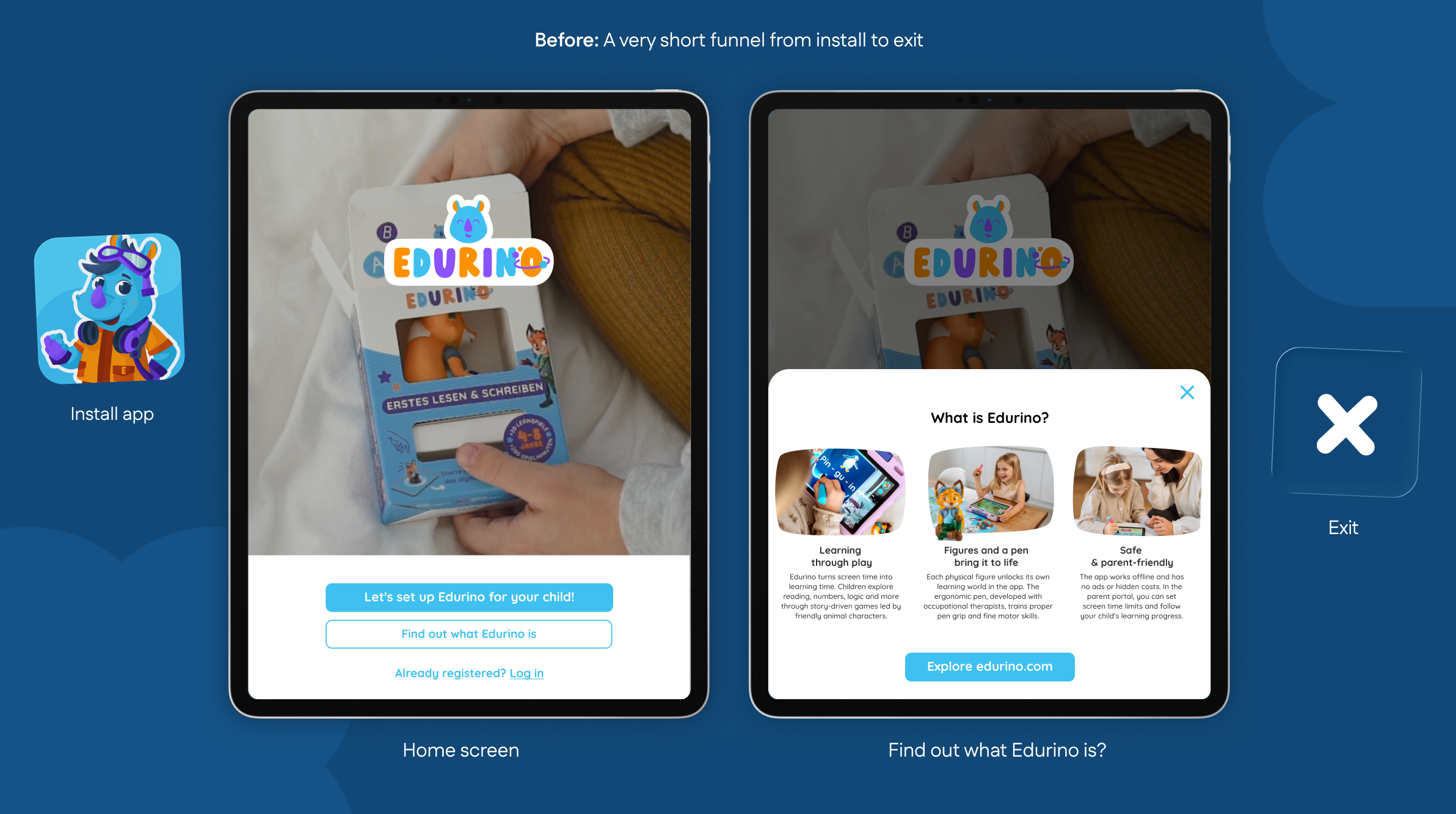
Before: a very short funnel from install to exit. Install the app, a home screen asking to set up Edurino, a “What is Edurino?” explainer, then exit.
The old flow: without a figurine, new users hit a dead end after one explainer screen.
Research

Forming the hypothesis

To check why some people never turn into paying customers, we scheduled 8 on-site interviews with potential customers (parents + child/children of age from 4 to 8), people who had only heard of Edurino or were considering a purchase, but also people who never heard of the app.

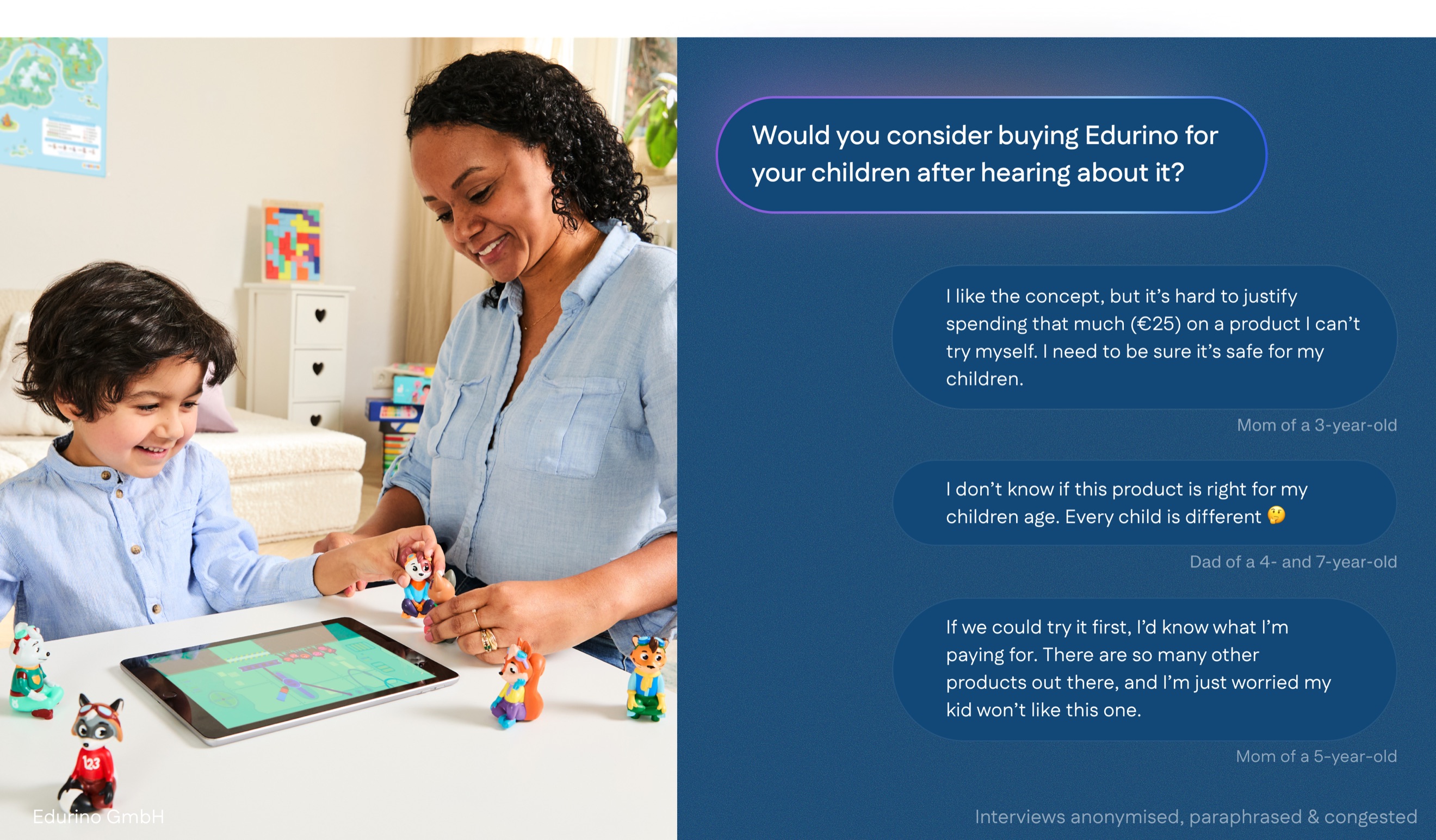
A few things parents told us (paraphrased):

A parent and child playing with Edurino figurines and a tablet, next to what parents told us. Asked “Would you consider buying Edurino for your children after hearing about it?”, a mom of a 3-year-old said it’s hard to justify spending 25 EUR on a product she can’t check herself; a dad of a 4- and 7-year-old wasn’t sure it was right for his child’s age; a mom of a 5-year-old said that if they could try it first, she’d know what she’s paying for.
We interviewed 8 families on site: parents with children aged 4 to 8.
Key takeaways
  1. For people who have never heard of Edurino, the entry threshold might feel too high: to see the product’s value, they first need to buy at least one figurine (approx. 15–25 €).
  2. Comparison to familiar patterns. Parents compared Edurino with other kids’ learning apps that let them test via trial mode, and asked why Edurino didn’t offer something similar.
Hypothesis

If new families can play before buying, they will trust the product enough to consider a purchase.

Solution

A way to try the learning experience for non-customers

We chose the smallest change that could test the hypothesis: redesigning the First Time User Experience.

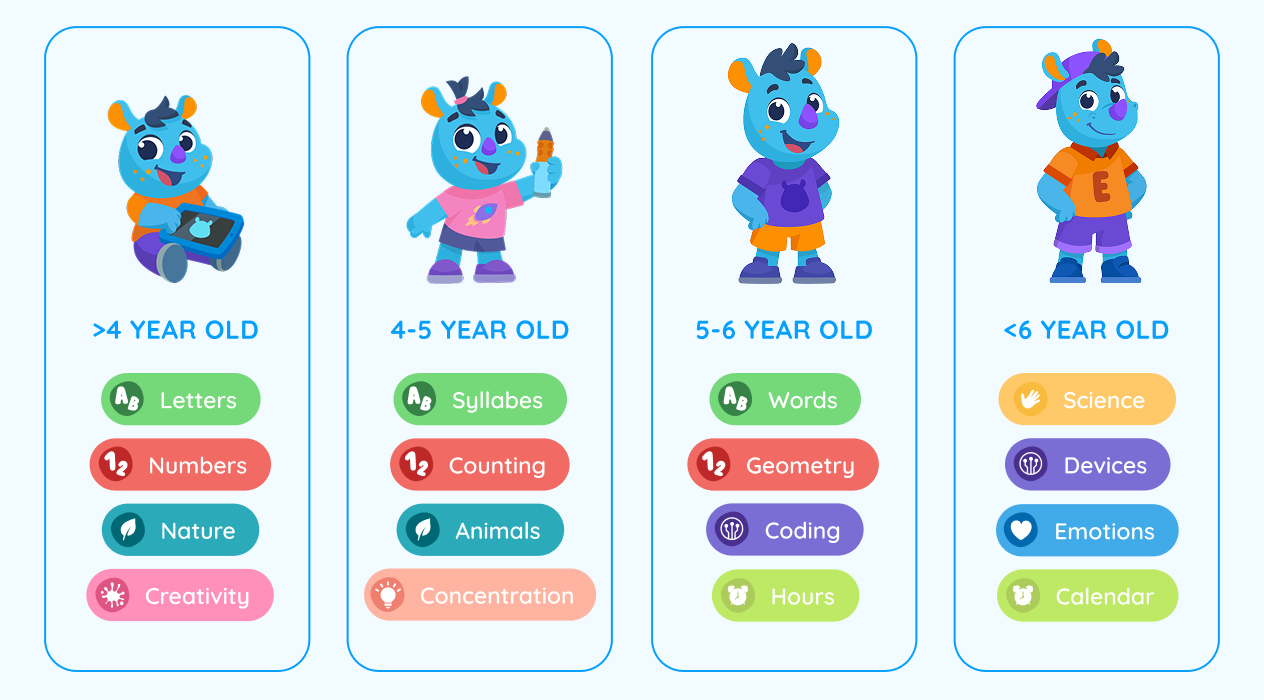
New users without a figurine were now asked two questions during onboarding: their child’s age and their interests. Based on the answers, the app surfaced two minigames from the existing pool, matched to that child, letting families play a relevant part of the product before buying anything.

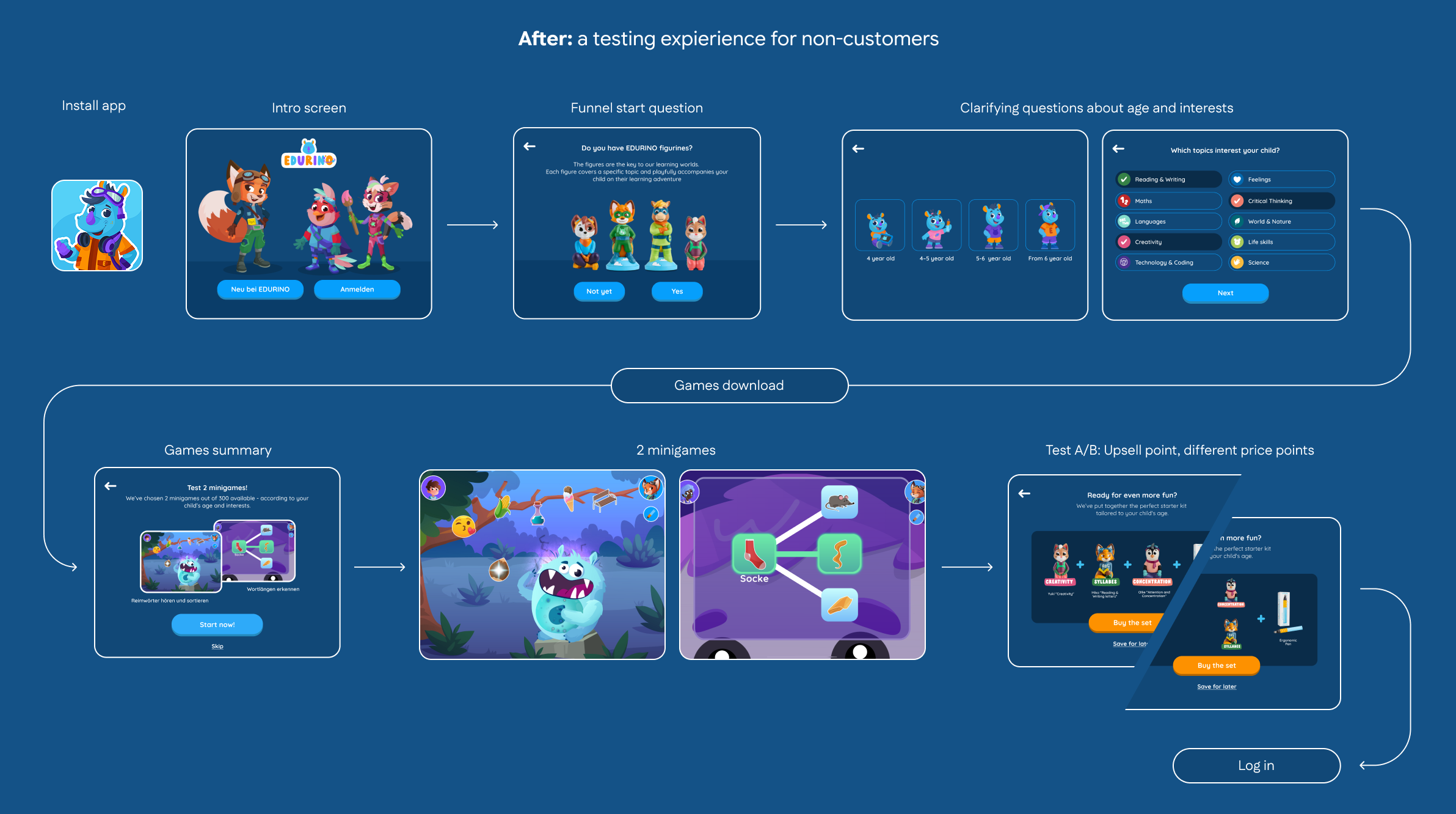
After: a testing experience for non-customers. Install the app, intro screen, a question about owning figurines, questions about the child’s age and interests, games download, a summary of two matched minigames, the two minigames, then an A/B tested upsell with different price points, and log in.
Before: a very short funnel from install to exit. Install the app, a home screen asking to set up Edurino, a “What is Edurino?” explainer, then exit.
Before After
Drag to compare the old dead-end flow with the new trial flow for non-customers.
Key decisions

What we did to make it right

  • Free trial instead of a subscription trial. I proposed letting new families play existing games for free instead of building a subscription trial. It fit the figurine business model, and it was far less work, so we could test the hypothesis sooner.
  • 2 trial games per session. Together they take under 10 minutes to play: enough time to experience the content, and a small enough download to keep the first session fast.
  • Keep the onboard questions sweet and short. Age and interests were all we needed to match suitable games, so we kept onboarding as short as possible.
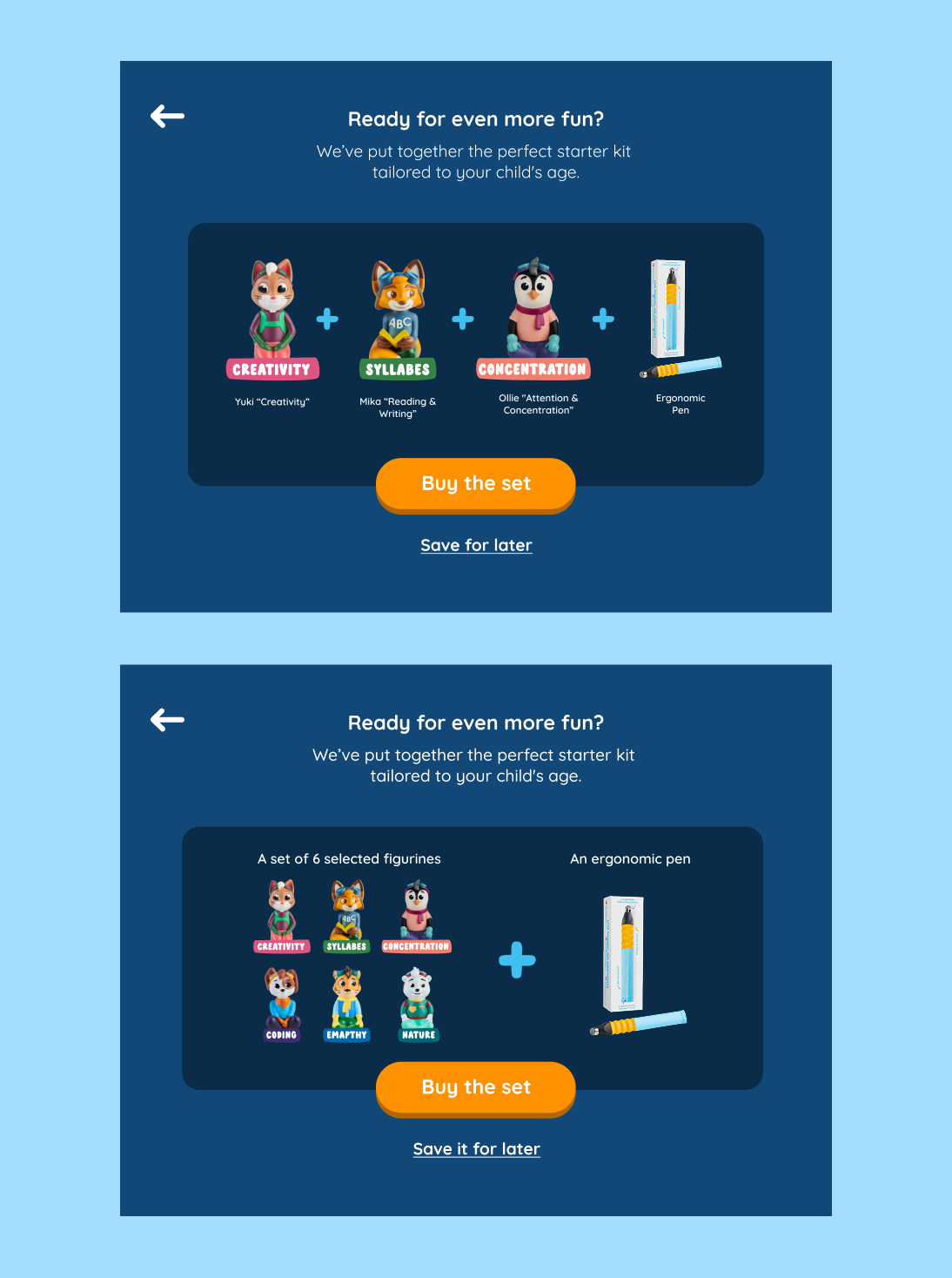
  • An upsell screen as an A/B experiment. After the trial games, part of the audience saw an offer to buy a figurine. We wanted to learn whether the demo alone could trigger a purchase.
Four age groups, from under 4 to over 6, each with the learning topics that suit it
Two versions of the upsell screen: a starter kit of three figurines and a pen, and a set of six figurines and a pen
Matching ages and interests to the right games · Animated buttons for picking interests · An A/B test of two different offers
Outcome

A demo that earns trust and showcases new games

About 50% of new users without a figurine started a trial game. Their sessions got consistently longer and no longer ended abruptly at the figurine screen. (Exact figures are confidential.)

The hypothesis held halfway: playing first built trust, but it didn’t lead to a purchase on the spot. Follow-up sessions showed parents felt the offer came too early, so we phased out the upsell and kept the demo, which families liked.

The upsell still gave us a useful answer. Across 5 A/B tests on in-app offers, I learned what parents would accept as a first purchase: a starter kit of 3 figurines and a pen.

The demo is still part of the app today, and the concept has grown beyond onboarding: the same try-out format is now used to showcase new games whenever the company launches them.
The full flow: from install, through two matched trial games, to the upsell.

We ran 3 on-site testing sessions to see whether the flow met parents’ expectations and whether it would move them towards a purchase. Both kids and parents liked the free trial games. However, parents weren’t convinced by the upsell screen. As the main reason they mentioned that the device usually belonged to the child, and they didn’t want to be pressured by their kids into buying figurines on the spot. Some of them said that it was simply too early for the decision.

Learnings
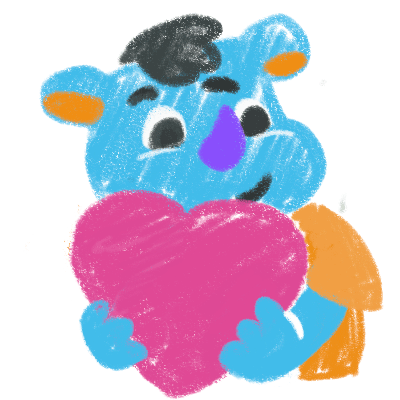
A blue mascot hugging a big pink heart

Building trust
early

Rather than a funnel with a direct revenue outcome, test-before-buy is better understood as one touchpoint in a longer, multi-session decision process. It builds trust and familiarity early, even if the purchase happens somewhere else, later, on a different device.

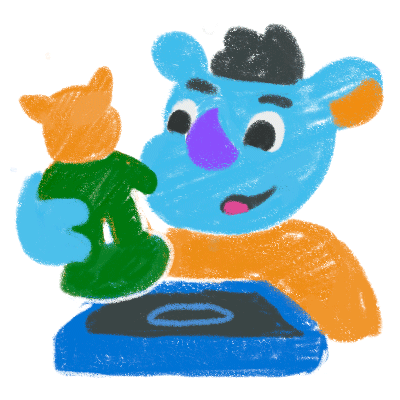
The mascot holding a figurine above a tablet

Hybrid nature
of a product

The key to the games is physical (the figurine), so buying one involves real-world delivery, which naturally puts distance between the demo and the purchase decision.

The mascot with a tablet, and a hand holding up a phone

Kids and parents
use different devices

Kids often play on their own device, separate from the parent’s, so the person who makes the purchase decision won’t buy on a kids-only device.

More at Edurino

Other work, 2023–2026

This case study is one selected project. Alongside it, I worked on:

  • Onboarding, purchase flows and the parental gate for an app used by 200k+ families, within App Store rules for kids’ apps.
  • Usability interviews on the first-time experience, which led to a shorter, rewritten flow with visual instructions.
  • Integrating external partner IP into the app flow.
  • A UI playbook for designing for children and parents, co-created with the team; coordinating UI guidelines with 2D artists and tech artists.
  • German and English localisation.